
Workshop Report The 8th EU-Japan Young Scholars Workshop / 2025 International New Generation Workshop (2025.11.28-30)2026/01/19
Workshop Report
The 8th EU-Japan Young Scholars Workshop on Transnational Japan
‘Revisiting’ Transnational Relations between Japan and the West
日本と西洋のトランスナショナルな関係[再訪]
■Organizers:
・Hosei University Research Center for International Japanese Studies (HIJAS)
・Consortium for Global Japanese Studies (CGJS)
・European Center for Japanese Studies in Alsace (CEEJA)
▶日本語レポートはこちら
From November 28 to 30, 2025, Hosei University Research Center for International Japanese Studies (HIJAS) hosted an international workshop titled “Revisiting Transnational Relations between Japan and the West.” This workshop, jointly organized by HIJAS and the European Centre for Japanese Studies in Alsace (CEEJA) with support from the Consortium for Global Japanese Studies (CGJS), marked its eighth session. While previous workshops were held in Colmar, France, this year’s event took place at Hosei University in Tokyo. Despite the change in location, the workshop maintained its intensive format, bringing together keynote speakers and early-career researchers from Europe and Japan for three days of extensive discussion. We invited two keynote speakers from Europe: Claire Akiko-Brisset (Professor, University of Geneva) and Thierry Hoquet (Professor, Paris Nanterre University). Additionally, eleven early-career researchers from Europe and Japan, selected through an open call, gathered in Ichigaya, Tokyo. Since some presenters were affiliated with multiple research institutions, several participants also had affiliations with universities in the United States. The event brought together researchers from various regions, including Spain, Italy, Switzerland, France, Germany, Lithuania, Ukraine, the US, China, and Japan, thereby making the workshop highly diverse (please see the program for details).
We set this year’s theme as: “‘Revisiting’ Transnational Relations between Japan and the West.” Since 2021, we have organized the workshop around the overarching theme of “Japanese Transnationalism,” building on discussions from “Japanese Studies and Transnationalism” (2021), “Japanese Transnationalism and Empire” (2022), “Transnational Change in Contemporary Japan” (2023), and “Transnational Japanese Spaces” (2024). In this context, this year we aimed to revisit the longstanding question of Japanese studies—the relationship between Japan and the West—while integrating a transnational perspective. Underlying this idea was the recent ‘crisis’ of the ‘West.’ Since the Meiji period, modern Japan has formed through its interaction with the West.’ The collective consciousness of becoming and overcoming the ‘West’ persisted, at least until the 1980s, when Japan’s economic growth peaked. However, this very ‘West’ is currently facing a ‘crisis.’ Immanuel Todd, a French demographer and public intellectual who is also well-known in Japan, recently published several books that include the title ‘The Defeat of the West (La Defaite de L’Occident)’ (In Japanese: 『西洋の敗北―日本と世界に何が起きるのか』文藝春秋、2024年; 『西洋の敗北と日本の選択』文藝春秋、2025年). Todd analyzes the challenges facing ‘the West,’ citing factors such as the Russia-Ukraine war, the decline of Western democracy and American-style capitalism, and the waning influence of Protestantism. Within this framework, Todd’s positioning of Japan is ambivalent; while he places Japan within a broader ‘West’ defined by economic and educational standards, he remains uncertain whether Japan belongs to what he calls the ‘defeated West.’ Given this rapidly changing world order, the aim of this workshop was to ‘revisit’ the long and complex transnational relationship between Japan and ‘the West.’
The first day (November 28) began with an introduction to the workshop’s aim. In her opening remarks, Professor Yasuko Yokoyama (Director of HIJAS) expressed her curiosity about how the term ‘revisit’ would be discussed in the workshop. The first day’s session, titled “Japan and the West in Culture and Literature” (Chair: Kei Takata), featured an opening keynote presentation by Claire-Akiko Brisset, ‘Cinema as a Transnational Phenomenon: The Case of the Reception of Japanese Cinema in France before 1945.’ This talk offered a detailed examination of the reception of Japanese cinema in pre-war France. Drawing extensively on film festival archives and other sources, Brisset explained how specific Japanese films were introduced to France from the 1920s to the 1940s, revealing the construction of the Japanese image in France through cinema. Following the lecture on the transnational history of Japanese cinema, Dingding Wang (University of California, San Diego / Nagoya University) gave a critical analysis of Yasujiro Ozu’s film The Munetaka Sisters (1950). Focusing on elements like plants and animals, lighting, and characters’ clothing, among others, the presentation explored how ‘Japanese’ and ‘Western’ elements coexist in Ozu’s film. Next, Daniele Durante (University of Venice / Kanagawa University) analyzed the representations of ‘the West’ and ‘Japan’ in Nobuko Yoshiyuki’s novel Forget-Me-Not (1932). The presentation argued that while ‘Japan’ represented the ideal wife, mother, or good daughter, ‘Western’ was associated with promiscuity (nanpa) and delinquent girls. From this analysis, the story of a romance between two girls, symbolizing ‘Japan’ and ‘the West,’ was seen as a narrative where ‘Japan’ successfully ‘detoxified’ ‘the West.’ Similarly, Yan Chang (Stanford University / Waseda University) examined Junichiro Tanizaki’s 1911 work Shōnen. His presentation viewed the depiction of ‘animalistic imitation’ in Tanizaki’s work as a strategy to subvert the Western gaze of ‘servile mimicry’ directed at Japan’s Westernization. The final presentation of the first day, by Momoe Hamachi, focused on transnational dolls, examining how dolls move across national borders between Japan and other countries. Hamachi traced the shift from the international project of the 1920s, “Blue-Eyed Dolls” by Eiichi Shibusawa, to the transnational dolls of the 1960s, exemplified by representations of bodies that transcend the state in the works of Beller, Shibusawa, and Simon. After these five detailed presentations in cultural and literary studies, we held a concluding discussion. During this, key themes for the workshop were reaffirmed, including the idea that ‘the West’ is both an imagined community and one whose (geographical and ideological) boundaries change over time. There was also an emphasis on understanding the relationship between ‘Japan’ and ‘the West’ through the lens of multiple modernities, a concept introduced in the 1990s.
On the second day, we held a session titled “Japan and ‘the West’ in Political and Religious Histories” (Chair: Christophe Thouny). The first presentation, by Qiaoyu Han (University of Tokyo), discussed the anti-Christian movement in the early Edo period. Han argued that China exerted transnational influence on the anti-Christian movement in Japan, illustrated by the connections among Japanese monk Sessō Sōsai, Chinese monk Feiyin Tongrong, and others. The following presentations focused on modern political and social history. Alberto Zizza (University of Munich / German Institute for Japanese Studies) analyzed Japanese identities articulated by Meiji-era intellectuals Haga Yaichi and Okakura Yoshisaburō, noting that their nationalist ideas for modernization within the Japanese tradition were paradoxically shaped through dialogue with ‘the West.’ The next presenter, Enrique Mora Roas (Open University of Catalonia), examined the transnational history of Japan’s early socialist movement. While previous research has focused primarily on the US, the UK, France, and Germany, this presentation examined relations with nations on the ‘periphery of the West,’ emphasizing Yamakawa Hitoshi’s analysis of the Italian Socialist Party. The fourth presenter, Daniel Wollnik (Ruhr-University Bochum), analyzed Japanese correspondents in Germany during World War II through the lens of transnational fascism. Using extensive archival materials, Wollnik revealed that the number of Japanese correspondents in Berlin was significantly higher than in other countries and that these correspondents, granted privileged status, were expected to produce pro-Nazi reports. The final presentation on the second day, by Gundė Daukšytė (University of Heidelberg), addressed transnational memory practices. It demonstrated how the 2004 EU enlargement to include Eastern European countries expanded the issue of Siberian internment of Eastern Europeans into a ‘Western’ problem. As a result, a transnational civil society has emerged that collectively remembers the Siberian internment between Japan and Lithuania. After the final presentation, we held a wrap-up discussion for the day. Thouny began by asking how we should think about the issue of universality that haunts the concept of ‘the West.’ The subsequent discussion noted that Western modernity, including communism, was a project of universality and thus inherently involved power dynamics between ‘the West and the Rest.’ As Brisset critically noted, these interrelations among ‘the West,’ universality, and power even extend into the academic world, as seen in Western dominance within the humanities and social sciences.
The theme of the final day was “Transnational Relations in Post-War Japan,” and we delivered two presentations on the topic. The first presenter, Wolfgang Gerhard Thiele (Free University of Berlin), discussed the forced repatriation incident involving Taiwan democracy movement activists in Japan around 1968. He showed how protests against the deportations, led by intellectuals and activists, including Tetsu Nakamura (then President of Hosei University), connected with movements in the United States, ultimately leading to the establishment of Amnesty Japan. The next presentation by Mariia Kravets (Tohoku University) examined the representations of America in the works of two novelists, Nobuo Kojima and Ryu Murakami, through Homi Bhabha’s theory of ‘mimicry.’ Kravets argued that while Kojima’s texts depict the ‘mimicry’ of postcolonial Japanese, in Murakami’s works, ‘mimicry’ instead becomes a tool for local resistance against the US. The three-day workshop concluded with a keynote lecture by Thierry Hoquet (University of Paris Nanterre) titled ‘Greek Philosophy or Transnational Philosophy?: Boundaries, Translation, and Decolonization.’ This talk developed two arguments regarding the conceptual positioning of philosophy in a transnational context. First, Hoquet argued that the field of ‘philosophy’ needs to be specifically used to describe the intellectual trajectory originating in Greek philosophia, and we should not call other intellectual endeavors by this term. Second, ‘philosophy’ inherently possesses a transnational nature; even philosophy in Western Europe, often perceived as central, is the result of transnational diffusion originating from Greece. Based on these two points, Hoquet further emphasized the transformative nature of philosophy, which evolves over time through the incorporation of peripheral voices. This is demonstrated by the development of Japanese ‘philosophy’ since the modern era, which has evolved uniquely through the blending of Buddhism, Confucianism, and Western philosophy.
Following the final keynote address, we held a one-hour closing discussion to synthesize the topics from the past three days. This session examined various arguments, starting with the core, long-standing question of whether ‘the West’ is a geographical region or an idea. Let me summarize the insights from these discussions. As mentioned earlier, whether seen as a region or an idea, ‘the West’ is a shifting concept. As Daukšytė’s presentation also highlighted, after the Cold War ended, many Eastern European countries became part of ‘the West.’ In this sense, one could argue that modernization essentially coincided with the expansion of ‘the West.’ Conversely, the question of whether Japan is part of ‘the West’ is difficult to answer. However, this difficulty highlights Japan’s unique traits. In the original geographical sense, Japan, located in the Far East, does not belong to ‘the West.’ Yet, following Todd’s argument or Stuart Hall’s discussions on ‘the West and the Rest,’ Japan qualifies as part of ‘the West’ because of its high economic and educational standards and its democratic political system. Japanese modernization was a process in which a country geographically distant from ‘the West’ came to be ideologically part of ‘the West’ quite quickly. Looking retrospectively, such a conjunction of Japan and ‘the West’ captured Western interest in Japan and became a source of pride for the Japanese people throughout their modern project. The coexistence of ‘the West’ and ‘Japan’ is evident in much of Japan’s modern culture, as demonstrated in the presentation by Wang, Durante, and Chang. Additionally, in the field of ‘philosophy,’ the example of the Kyoto School illustrates this, blending Greek-origin ‘philosophy’ with Buddhism and Confucianism (Hoquet). This workshop reaffirmed that many scholars of Japanese studies, in their own ways, have argued how this unique relationship between Japan and ‘the West’—not shaped by direct colonial pressure—has influenced Japan’s modernity.
From a geographical perspective, Japan is a nation-state, whereas ‘the West’ is a collection of diverse states. Therefore, ‘the West’ is also varied. As shown in the presentations, Japan’s relationship with ‘the West’ shifted focus as the dominance of the world system moved from Western Europe to the United States around World War II. Additionally, Western countries with which Japan maintains ties differ across fields—economics, politics, culture, academia, and more. For example, in cinema, Japan’s connections seem stronger with countries like France and the United States, which is understandable given those countries’ dominance in the industry (Brisset). Furthermore, when discussing transnational relations, the ‘meaning of ties’ is important. The workshop presentations explored different types of transnational relationships: resistance to Christianity (Han), nationalist resistance (Zizza), communist connections as an alternative path (Mora Roás), fascist ties (Wollnik), connections or resistance within civil society (Thiele; Daukšytė; Kravetz), and relations going against the nation-states (Hamachi), among others. From these analyses, it’s clear Japan has ‘connected’ through ‘various West,’ with different forms including ‘opposition’ to, as well as defeat by, ‘the West.’ It’s worth noting that, even though Japan opposed the ‘West,’ it also became ‘Westernized’ through that opposition. For instance, during the nationalist ‘resistance’ to the ‘West’ in the Meiji era, Japan constructed its traditions through interaction with ‘the West.’ Similarly, in the postwar period, Japanese citizens protested against the US via a form of Western civil society, which led to Japan becoming more ‘Westernized.’ Additionally, from the West’s perspective, Japan was ‘discovered’ because its forms—not only political institutions and economic systems but also culture—became ‘Westernized.’ This is because differences become apparent once the forms are unified.
Finally, an important question was raised during the discussion about the usefulness of ‘the West’ as an analytical concept. As a concluding point, I will offer a few tentative answers to this question. As discussed in the workshop, ‘the West’ is a broad and ambiguous term whose meanings vary across different eras and among scholars. To be sure, this ambiguity makes it less effective for scientifically understanding political and cultural phenomena. However, the concept of ‘the West’ can still be useful for highlighting characteristics of Japan. For example, looking at how the Japanese people have received, perceived, and grappled with ‘the West’ over time can serve as a lens for understanding the evolution of Japanese identity. Furthermore, given the current ‘crisis,’ the term ‘West’ seems to be gaining new, significant meanings in politics. As we observe, the landscape surrounding ‘the West’ is going through major changes as tensions between ‘the West and the Rest’ grow and disparity within ‘the West’—such as between Europe and the U.S.—becomes more apparent. As ‘the West’ faces ‘crisis,’ how Japan, which has positioned itself as the ‘periphery of the West’ or an ‘Eastern country closest to the West,’ will develop new relationships with ‘the West’ is an important question for understanding the future of Japan and the world.
While the time difference associated with holding the event in Tokyo made online participation from Europe difficult, we also observed new dynamics, including an increase not only in online but also in in-person attendance among colleagues and friends of the presenters. The operational challenge was to take advantage of the benefits of an urban setting while maintaining the strengths of the previous small-scale, intimate dialogue format. Given the workshop’s themes, which sometimes touched on sensitive issues, the first-day discussions were somewhat awkward. However, by the final day, we saw open exchanges rooted in trust, reaffirming the value of small-scale, intensive workshops.
Finally, we received various supports to organize the workshop from the following commentators and observers:
Brendan Le Roux Kiyono (Hosei University), Christophe Thouny (Ritsumeikan University), Erich Pauer (CEEJA), Hideto Tsuboi (Waseda University), Josef Kyburz (CNRS), Masashi Oguchi (Hosei University), Nozomi Takahashi (Strasbourg University), Regine Mathias (CEEJA), Shin Abiko (Hosei University), Stevie Suan (Hosei University), Tsutomu Hoshino (Hosei University), Yasuaki Kimijima (Hosei University), Yasuko Yokoyama (Hosei University), Yusuke Suzumura (Meijo University) [in alphabetical order]
We also sincerely thank the administrative staff for their assistance in organizing this year’s event. We couldn’t have done it without their support.
Kei Takata (Hosei University)
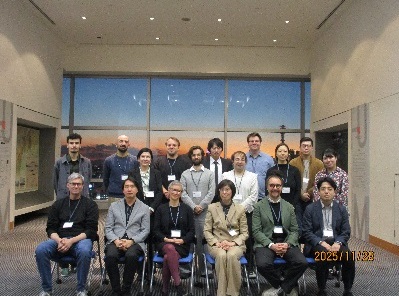 First Day: At the conference venue (Boissonade Tower) |
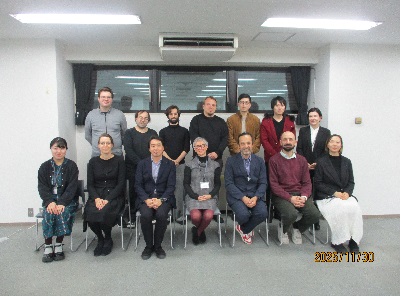 Final Day: After the concluding discussion |
This work was subsidized by the Consortium for Global Japanese Studies in FY 2025.
