
Award Ceremony “11th Professor Josef Kreiner Hosei University Award for International Japanese Studies”2026/02/13
Award Ceremony
“11th Professor Josef Kreiner Hosei University Award for International Japanese Studies”
Date/Time: January 20th, 2026, 16:00-17:30 (JST) [Face to Face + Online via Zoom]
■Award Winner Ryo Morimoto (Harvard University)
■Moderator Yasuko Yokoyama(Hosei University)
■Opening Remarks Kei Takata(Hosei University)
■Congratulatory Address Josef Kreiner(Hosei University)
On January 20th, 2026, the Hosei University Research Center for International Japanese Studies (HIJAS) hosted an award ceremony for the “11th Professor Josef Kreiner Hosei University Award for International Japanese Studies.” The award has been created to publicly celebrate Professor Josef Kreiner in his remarkable academic efforts to promote Japanese studies and to encourage Japanese studies scholars residing outside of Japan. After careful consideration, our selection committee has selected Dr. Ryo Morimoto from Harvard University Reischauer Institute of Japanese Studies for his work, Nuclear Ghost: Atomic Livelihoods in Fukushima’s Gray Zone (University of California Press, 2023).
This year’s award ceremony was a long-awaited in-person event, with the recipient, Dr. Ryo Morimoto, traveling from Boston, USA, and Dr. Kreiner also attending in Ichigaya, Tokyo. The ceremony began with a presentation of the main award certificate from HIJAS Director Yasuko Yokoyama. Then, in his opening remarks, Takata outlined the award-winning work and its notable features as follows: First, the book’s achievement is its publication as a comprehensive English-language work that vividly depicts the actual living conditions and consciousness of Fukushima residents after 3.11. As a ‘native anthropologist,’ the author conducted detailed fieldwork in Minamisoma City from 2013 to 2020, documenting the realities of the local community affected by the Fukushima Daiichi nuclear disaster. Post-accident Fukushima has been shaped by a narrative based on ‘scientific findings’ about radioactive levels, leaving the daily lives of residents largely unseen. However, as the book title suggests, people have lived—and wished to die—in their hometowns, haunted by the ‘nuclear ghost.’ The author avoids portraying Minamisoma residents as mere ‘victims,’ instead delving deeply into the community, forging bonds (縁) with its people and gently uncovering their heartfelt struggles to reveal the complex, ambivalent anguish they carry. Furthermore, it effectively presents this reality to readers unfamiliar with Japan and Tohoku’s cultural and historical context, using compelling English language to engage them. This achievement is possible because the author, while a native Japanese speaker, has a deep understanding of English-speaking audiences, especially their view of Fukushima. Consequently, the book stands out as an exceptional accomplishment in ‘International Japanese Studies,’ bridging Japan and the world. In his congratulatory speech, Dr. Kreiner mentioned the award’s history and past distinguished winners, noting that it has served as a gateway for young scholars in Japanese studies. He praised Dr. Morimoto’s book as a notable example, calling it an excellent contribution to International Japanese Studies. He also expressed hope that ‘International Japanese Studies’ would influence government policies and encouraged the integration of Mr. Morimoto’s anthropological insights into policies for disaster-affected regions.
Following the award ceremony, Dr. Morimoto delivered a commemorative lecture titled “Nuclear Ghost: Atomic Livelihoods in Fukushima’s Gray Zone in 2026.” This presentation provided an overview of the book, including its perspective as of 2026, and introduced a new project he recently started. His talk raised several anthropological questions about the realities of post-3.11 Fukushima. For example, it examined how boundaries based on radiation levels—completely separate from regional boundaries rooted in people’s lives—were established, significantly impacting locals’ daily routines and sense of awareness. Additionally, decontamination of soil collection sites was described as making the invisible ‘ghost’ of radiation visible. Nearby residents were said to experience ambivalent feelings about these visible nuclear wastes: viewing them positively as proof that contamination was being removed, yet also feeling that their ancestral land was being sullied. Finally, Mr. Morimoto discussed his new project: anthropological research into robotics technology in Fukushima. While recognizing its usefulness, he expressed concern that deploying robots may inadvertently divert attention from people confronting nuclear disaster. Already fifteen years have passed since the Fukushima nuclear accident, and Dr. Morimoto’s award lecture was a valuable presentation that once again challenged our perceptions of Fukushima and helped us better understand the realities faced by its residents.
This year’s award ceremony presented a new challenge, as the recipient based in the United States delivered the lecture in English. Nonetheless, it proved to be a meaningful event that successfully conveyed the achievements of the winning work. We will continue to encourage submissions of outstanding works related to Japan from around the world.
Kei Takata (Hosei University)
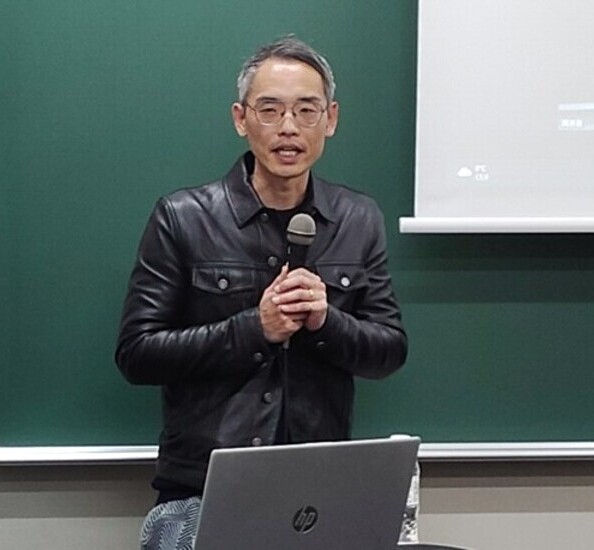 Dr. Ryo Morimoto Award Winner |
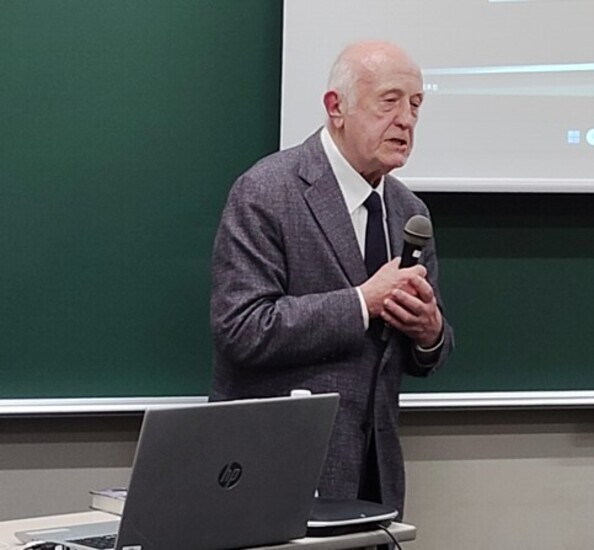 Josef Kreiner (Visiting Researcher of HIJAS) |
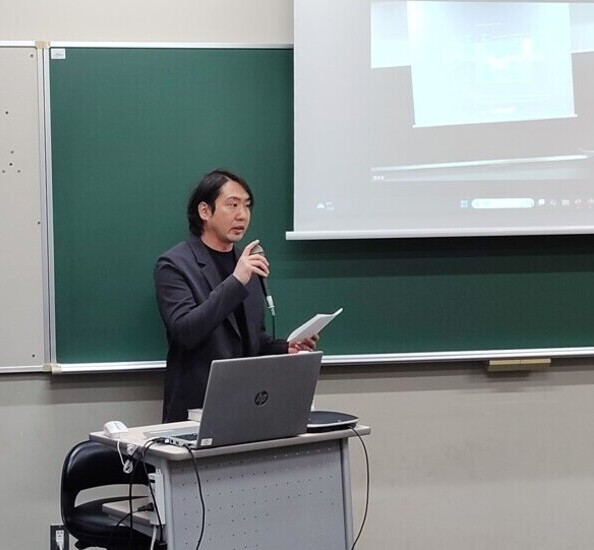 Kei Takata (Full-Time Researcher of HIJAS) |
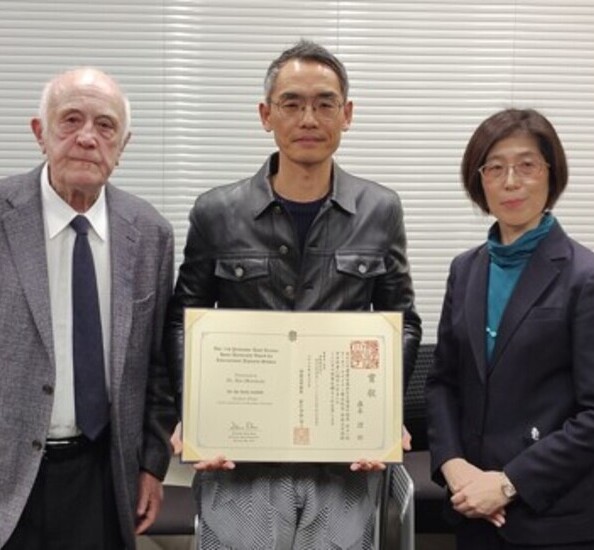 Josef Kreiner(Visiting Researcher of HIJAS), Dr. Ryo Morimoto, and Yasuko Yokoyama(Director of HIJAS) (left to right). |
